
Nanoparticles: Enhancing Aromatherapy's Tomorrow
Dr. Lidón Avinent, February 7, 2022.
The volatility of essential oils is one of the characteristics that make them perfect for aromatherapy when applied through the olfactory pathway. However, their rapid rate of evaporation weakens their action. Therefore, there is considerable effort being invested in finding means that allow for controlled release of aromatic compounds from oils.
Nanotechnology involves the study and manipulation of matter in incredibly small sizes, typically between one and 100 nanometers (1), and it is applied across various fields such as food, agriculture, medicine, information technology, communication, energy, and the environment, among others. It promises significant scientific advancements in all its application domains.
The technology of nano-materials has emerged as a promising tool in the research of medicinal and aromatic plants (MAPs) (Prairna et al. 2020). Active components of MAPs can be encapsulated in nanoparticle form to address issues like solubility, volatility, overly strong aromas, efficacy improvement, etc. A wide variety of nanomaterials (Nair et al. 2021) are used to encapsulate the molecule of interest and then release it in a controlled manner.
In 2013, Flores et al. published an article where formulations with nanocapsules and nanoemulsions of tea tree oil (Melaleuca alternifolia) showed higher activity in their antifungal action against onychomycosis compared to simple emulsions and the control.
More recently, researchers (Lu et al. 2020) encapsulated citral, the main component of lemon essential oil with antidepressant properties, in these particles. When applied to wallpaper, these components were capable of exerting their antidepressant and anti-stress effects (laboratory trials).
In another study, Wang et al. (2020) designed nanoparticles encapsulating eugenol, observing a slowed release dose of this molecule affecting the central nervous system.
In a different study, the encapsulation of linalool, a molecule with effects on the central nervous system used to alleviate stress, was investigated. Its release is promoted under acidic conditions and suppressed under alkaline conditions, thereby providing an aromatic particle with pH-sensitive release properties, holding significant potential for aromatherapy.
The team led by Yang, Yang et al. (2021), synthesized nanoparticles encapsulating bergamot essential oil, studying parameters such as thermal stability, encapsulation efficiency, and slow-release properties of this oil used for depression management. The initial laboratory results show that this new "nanoaromatic medicine" has excellent antidepressant effects.
(1) 1 mm = 106 nm
(2) From English "medicinal and aromatic plants."
The management of common acne vulgaris can be improved with a nanoemulsion containing niaouli essential oil (Melaleuca viridiflora), as it enhances skin penetrability and bioactivity against acne-causing pathogens (Shakeel et al., 2021).
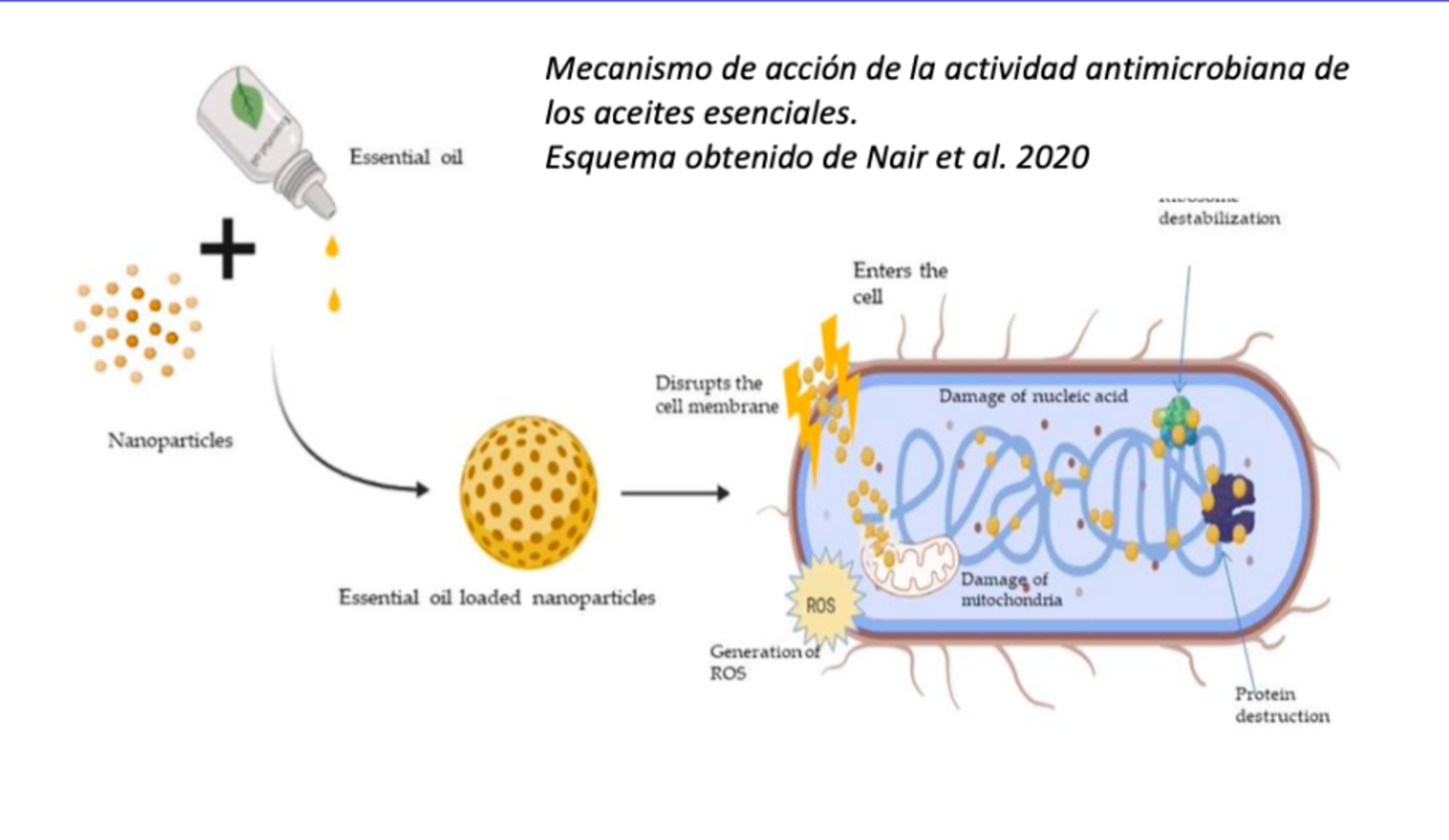
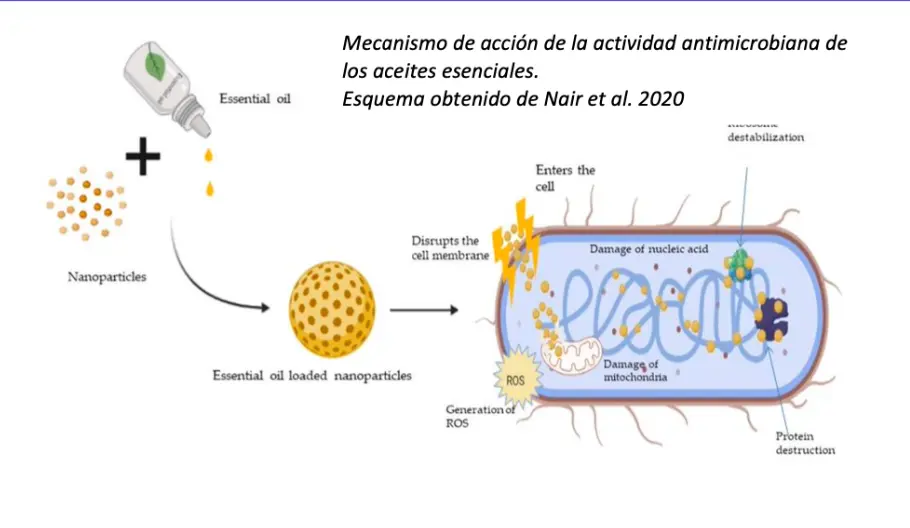
The work by Nair et al. (2021) reviews the role of nanoparticles as interesting carriers of antimicrobial essential oils. Due to the excessive use of antibiotics and the consequent emergence of resistances, many strains of bacteria, viruses, fungi, and parasites have developed resistance. Essential oils, owing to the diverse structural and biological composition of their components, provide a distinctive and inexhaustible method of pathogen control, a function somewhat limited by their high volatility. Nevertheless, the use of nanoparticles composed of biodegradable and inorganic materials is being studied to address these limitations. Essential oils loaded into these materials offer potential benefits such as synergistic actions, improved solubility, reduced volatility, enhanced chemical stability, improved bioavailability, and longer storage times. This represents a clear example of new therapeutic products that will aid in the management and control of infectious diseases. The review by these authors constitutes an excellent document for:
Understanding the different oils' actions (a summary table of 28 oils, their components, and mode of action is interesting) against various bacterial pathogens, attacking either through the cell membrane or inducing cell apoptosis by attacking at the nuclear level. Analyzing the issues related to the stability and bioavailability of the oils. Understanding their combination with allopathic antibiotics.
Comprehending how nanotechnology can assist in oil use by shielding them from heat and UV light, ensuring greater stability, increased aroma retention, functionality, and, above all, controlled release to achieve prolonged therapeutic effects.
Once again, multidisciplinary approaches are indispensable for progress. Physics, chemistry, biology - and mathematics as their foundation - converge to provide us with better tools. Let us make good use of them.
Mechanism of action of the antimicrobial activity of essential oils. Diagram obtained from Nair et al. 2020.